Skip to main content

E-Bikes in Colorado: Laws, Injuries & Your Rights
E-bikes are everywhere in the Denver metro right now. You see them on the Cherry Creek trail, in bike lanes in downtown Denver, and buzzing through neighborhoods in Centennial, Parker, Castle Rock, and Highlands Ranch. They are fun, affordable, and they get people outside. They also send a growing number of Coloradans, a lot of them kids, to the emergency room. This blog dives into what you need to know if you have been injured by or on an e-bike.
At Ready Law, we handle injury cases across the Denver metro and all of Colorado, and we have watched e-bike questions go from rare to routine. So here is a guide to what an e-bike actually is, what Colorado law says, what police are seeing, how people get hurt, and why these injury cases are trickier than a normal bike crash.
The three classes of e-bikes (and the machines that are not e-bikes at all)
Colorado, like most states, sorts e-bikes into three classes based on how the motor helps you and how fast it will take you. All three are capped at a 750-watt motor.
- Class 1: Pedal-assist only. The motor helps while you pedal and cuts out at 20 mph. No throttle. This is the most trail-friendly type.
- Class 2: Has a throttle, so it can move without pedaling, but the motor still stops at 20 mph.
- Class 3: Pedal-assist only, but the motor keeps helping up to 28 mph. These must have a speedometer.
Often, when people are thinking of e-bikes causing trouble in their neighborhoods, they are thinking of machines that are not legally e-bikes at all.
If a device has a motor over 750 watts, or if it has no working pedals, it stops being an e-bike under Colorado law and becomes something else. An electric scooter, for instance, is a device that weighs less than 100 pounds, has handlebars and an electric motor, is powered by an electric motor, and has a maximum speed of 20mph when powered solely by the motor.
Another possibility is a “low-power electric vehicle” or an “e-motorcycle” (often called an “e-moto”). Those can hit upwards of 30mph, sometimes as much as 65 mph, and they have motor power that is often in the 1,000 to 6,000-watt range. These machines legally require a driver’s license, registration, and insurance, just like a gas motorcycle. Many are sold online, look like bicycles, and are marketed in ways that blur the line. Some standard-looking e-bikes can also be “hacked” or modified to blow past their speed limits.
That gap between what people think they bought and what they actually own makes accidents and injuries especially complex.
Colorado e-bike law, in plain English
For a true Class 1, 2, or 3 e-bike, Colorado treats it a lot like a regular bicycle:
- No driver’s license, registration, or insurance required.
- Helmets: Required only for Class 3 riders under 18, and for Class 3 passengers under 16. The Colorado Department of Transportation (CDOT) recommends helmets for everyone, on every class.
- Minimum age: You must be at least 16 to ride a Class 3.
- Where you can ride: Class 1 and 2 are generally allowed on roads, bike lanes, and many bike and pedestrian paths unless a local government says otherwise. Class 3 is limited to roads and bike lanes and is kept off most off-street paths unless a city specifically opens them.
Importantly, by January 1, 2027, e-bikes will be required to have a label depicting the e-bike’s classification, top speed and motor wattage.
The most important thing to understand about Colorado is that the state sets a floor for e-bike laws, and then cities and counties build on top of it. Colorado hands local governments more power over e-bikes than almost any other state, and dozens of them have used it. That means the rules can change from one trail to the next in communities throughout Colorado, and so can the penalties involved for breaking them.
Here are a few Denver metro area examples:
- Centennial adopted stricter e-bike and off-road-vehicle regulations in 2026. In Centennial, Class 3 e-bikes and all e-motorcycles are prohibited on sidewalks and trails, but may be operated on city streets with the proper license, registration, and insurance, and in accordance with traffic laws. The ordinances are also particularly focused on prohibiting off-highway vehicles (like ATVs) on city streets or managed property.
- Greenwood Village amended its municipal code to ban low-power e-scooters and Class 3 e-bikes from city paths, trails, and sidewalks, and added signage prohibiting e-dirt bikes and e-motos. Greenwood Village also caps speed limits on trails and paths at 15mph and has instituted an online unsafe activity reporting tool.
- Parker never allows Class 3 e-bikes or e-motos / dirt bikes on any trails, sidewalks, or parks. Class 3 e-bikes are allowed on roadways. Parker also enforces a 15mph speed limit on all trails, and, like Greenwood Village, promotes an online unsafe activity reporting tool.
- Aurora, Douglas County, and Littleton are all weighing or passing their own ordinance, and deal with similar themes, like which classes of e-bikes are allowed where and on who must be wearing a helmet during operation.
The takeaway for riders: Check the posted signs and the local rules before you ride an unfamiliar path. What is legal on the street may be banned on the trail two blocks away.
What the police and doctors are seeing
This is where the story has changed fast, and it is worth paying attention to.
Children’s Hospital Colorado reported a 184% increase in traumatic e-bike or e-scooter injuries from 2024 to 2025 at its main hospital in Aurora, with similar numbers reported at its emergency room in Colorado Springs. The hospital’s Anschutz campus in Aurora logged about 100 traumatic e-mobility injuries across all of 2024 and 2025 combined, and has seen more than 60 in 2026 through August. An emergency medicine director there said she now treats at least one injured child from an e-bike or e-scooter during nearly every shift she works, and that those injuries surpass injuries from non-electric bicycles.
Law enforcement across the Front Range is responding. In a recent report from CBS Colorado, Erie police reported more than 70 incidents in two years involving high-powered motorized bikes. Boulder County deputies have stopped dozens of riders in the past year, including a 14-year-old clocked at 59 mph on an electric motorcycle. Another juvenile in Arapahoe County tried to get away from law enforcement using an e-bike in a residential neighborhood, often hitting high speeds and conducting risky maneuvers that could have resulted in injury. Officers throughout Colorado keep repeating the same message to parents on media reports: many families genuinely do not know that the machine their kid is riding is legally a motorcycle and not a bicycle.
Colorado State Patrol has partnered with Children’s Hospital to get ahead of the trend. Their advice is consistent and simple: read the label, know the wattage and speed, and never let a child ride without a helmet.
How people get hurt on e-bikes
An e-bike is heavier and faster than a regular bicycle, and it is much quieter, which makes it harder for drivers and pedestrians to notice. When something goes wrong, physics does the rest. A rider and bike together can weigh 300 pounds or more and arrive at car-like speeds.
Doctors and researchers describe e-bike crashes at higher speeds as looking less like a bicycle fall and more like a motorcycle wreck. The most common serious injuries include:
- Traumatic brain injuries and concussions. Riders, especially kids, tend to get thrown and land head-first. This is far and away the biggest concern doctors raise, and helmets are the single best defense. It is important to use the right helmet for the type of machine.
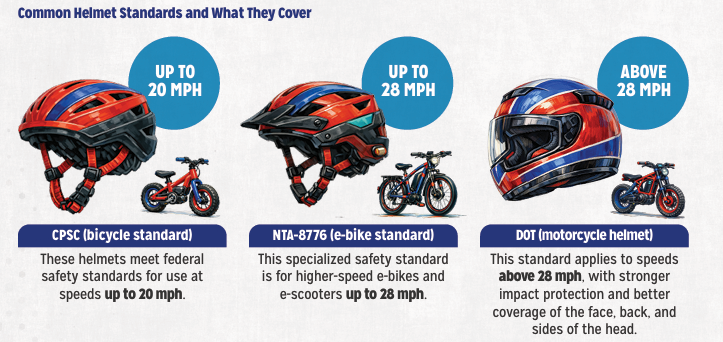
Helmet guidance for different types of machines, Source: AAA E-Ride Safety Guide
- Facial fractures and severe facial trauma.
- Spinal and neck injuries, including cervical spine damage.
- Broken bones, especially forearm fractures (the radius and ulna) from bracing for impact, plus rib fractures and lower-leg injuries.
- Internal bleeding and organ damage.
- Burns, in the smaller but serious category of lithium-ion battery fires.
National data tracks the Colorado trend. Emergency department visits for e-bike injuries have climbed sharply as ridership has grown, and studies show head, neck, and torso injuries make up a large share of the total. Crashes involving a motor vehicle are common, and riders without helmets face much higher odds of a head injury.
Why e-bike injury cases are different (and where people get blindsided)
This is the part most riders never think about until after a crash. E-bike cases carry legal and insurance wrinkles that a standard car or bicycle case does not. At Ready Law, here is what we watch for.
- The insurance gap: Because true e-bikes do not require insurance in Colorado, an at-fault e-bike rider often has no coverage of their own. Many homeowners and renters policies also exclude e-bikes specifically because they are motorized. So if an e-bike rider injures a pedestrian or damages a car, the money to cover it may simply not exist unless that rider carries a specialized policy, which is rare. That can turn into a fight over someone’s personal assets. If an e-bike rider is injured because a property is in disrepair or has a dangerous condition, the resulting premises liability claim can be complicated and can rest on a variety of factors, including whether the property owner should have known about the condition and whether the rider was reasonably on the property or if their conduct contributed to the injury. In all of these cases, a personal injury lawyer can help an injured party sort through the details of their unique case.
- Your own auto policy may still protect you: Here is the good news that surprises people. In Colorado, your uninsured/underinsured motorist (UM/UIM) coverage and MedPay generally follow you, not just your car. If you are hit by a negligent driver while riding your e-bike, your own auto policy, or a household family member’s policy, may respond, including in hit-and-run situations. Finding every possible source of coverage is often the difference between a small recovery and a full one, and a personal injury lawyer can help with that.
- Comparative fault, and insurers who blame the rider: Colorado uses modified comparative negligence. You can still recover damages as long as you are found less than 50% at fault, but your compensation is reduced by your share of the blame. Insurance adjusters know this and often try to pin fault on the rider. E-bikes give them extra ammunition, including arguments about speed, where the bike was ridden, whether the rider had the right to be there, and helmet use. Documenting the scene and the other party’s conduct early is critical.
- Was it even legal for that person to be riding? Whether a machine is a true Class 1, 2, or 3 e-bike, versus an unregistered e-motorcycle, can change the entire case. If the other party was operating an over-powered or modified device that legally required a license, registration, and insurance, that changes the duties they owed and the coverage that should have been in place. It is one of the first things worth investigating.
- Product liability and battery defects: Not every crash is about rider or driver error. If a battery catches fire, brakes fail, a throttle sticks, or a frame cracks during normal use, the manufacturer or seller may be responsible under product liability law. Given how many cheap, imported models are flooding the market, defect claims are a real and growing part of these cases.
- When the rider is a minor: Many of these crashes involve kids or teenagers, which raises hard questions about parental responsibility, where the bike came from, and how a young rider’s injuries and future are valued. These cases deserve careful, sensitive handling, and having an expert guide through the process is critical.
What to do if you or your child is hurt in an e-bike crash
If the worst happens, a few early steps protect both your health and your rights:
- Get medical care right away. Some of the most serious e-bike injuries, concussions and internal bleeding, are not obvious in the first hour.
- Call the police and get a report. An official record documents the scene and an early read on fault.
- Photograph everything. The bike, the vehicle, the road, any signs, and your injuries.
- Get witness names and numbers before people leave.
- Do not give a recorded statement to the other side’s insurer before you understand how it could be used.
- Save the bike and its paperwork. The make, model, wattage, and any modifications can matter a great deal, especially in a defect or classification dispute. If you were injured by an e-bike, contacting an attorney who can send out letters of preservation quickly is critical.
Under Colorado law, you generally have two years to file a personal injury claim tied to a motor vehicle, but do not wait. Evidence disappears, and coverage questions get harder to untangle over time.
How Ready Law can help
E-bikes are new enough that the law, the insurance industry, and a lot of families are all still catching up. That is exactly the kind of gap where someone who has been injured can get taken advantage of, or simply give up on a claim they had every right to pursue.
Attorney Vern Ready helps injured people sort out who is actually responsible, find every layer of insurance coverage that applies, and push back when an adjuster tries to shift blame onto the rider. We keep you informed at every step, and we prepare every case seriously from day one.
If you or someone in your family has been hurt in an e-bike, e-scooter, or e-motorcycle crash anywhere in Colorado, reach out to Ready Law for a free, straightforward conversation about your options. No pressure, just honest answers. Get Ready.